New Delhi, Aug 7 (INB) Government agencies have started a massive crackdown on social media accounts on Instagram and X that were linked to student protests at Jantar Mantar and ethanol blending with petrol.
The accounts that have faced action include that of Aam Aadmi Party Founder Arvind Kejriwal, Leader of opposition in Lok Sabha Rahul Gandhi, Cockroach Janta Party chief spokesperson Saurav Das, Alt News founder Mohammed Zubair and other influencers who carried content related to these protests.
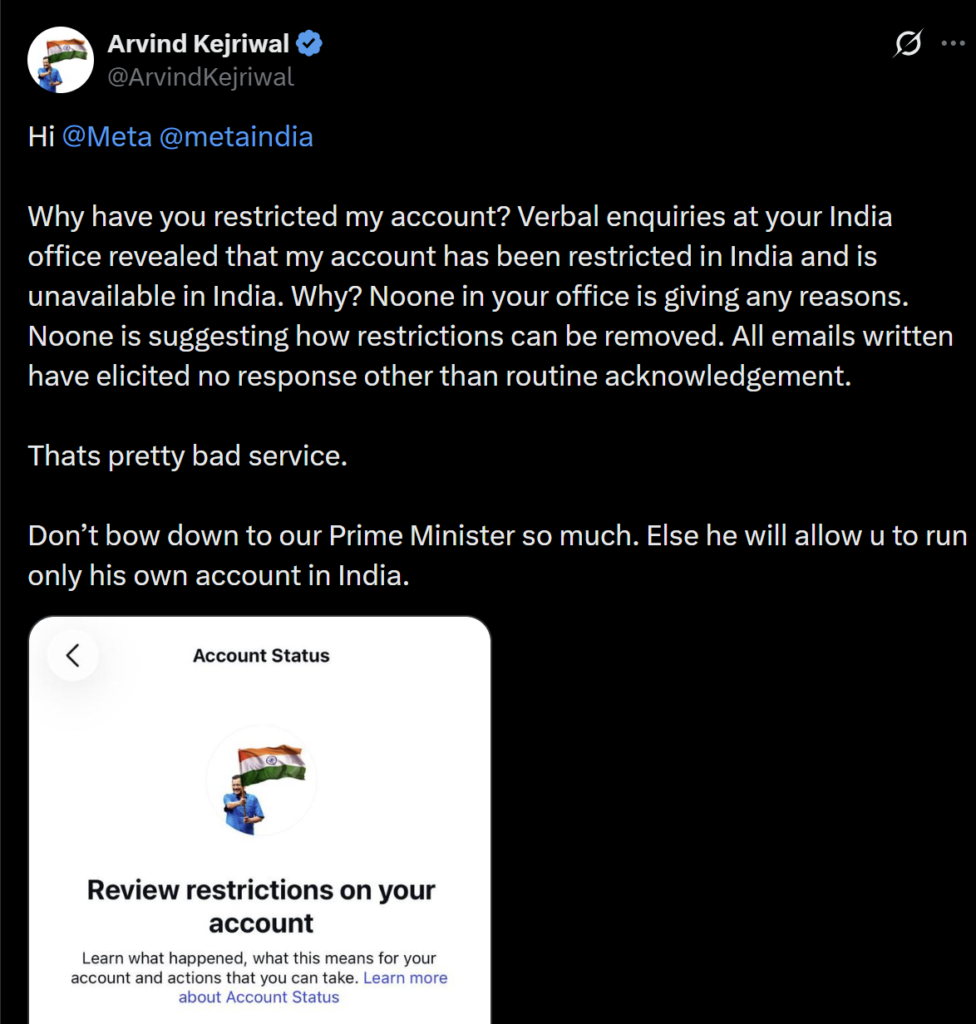
The issue was first flagged by Kejriwal that there has been action against his account.
Later several accounts posted actions on their Instagram account based on government requests.
“Hi @Meta @metaindia
Why have you restricted my account? Verbal enquiries at your India office revealed that my account has been restricted in India and is unavailable in India. Why? Noone in your office is giving any reasons. Noone is suggesting how restrictions can be removed. All emails written have elicited no response other than routine acknowledgement.
Thats pretty bad service.
Don’t bow down to our Prime Minister so much. Else he will allow u to run only his own account in India,” Kejriwal said on X.
Global delegation of Facebook and Instagram owner Meta is in India to comply with summon issued by the Ministry of Electronics and IT.
Government has flagged concern around removal of Prime Minister Narendra Modi’s video on Instagram on which he addressed to GenZ regarding their concern on the NEET paper leak.
Later Meity said that they also want to discuss with Meta other operational issues on their platform.
Several accounts on Instagram started facing action the very next day Meta officials met IT Minister Ashwini Vaishnaw and senior officials from Meity.
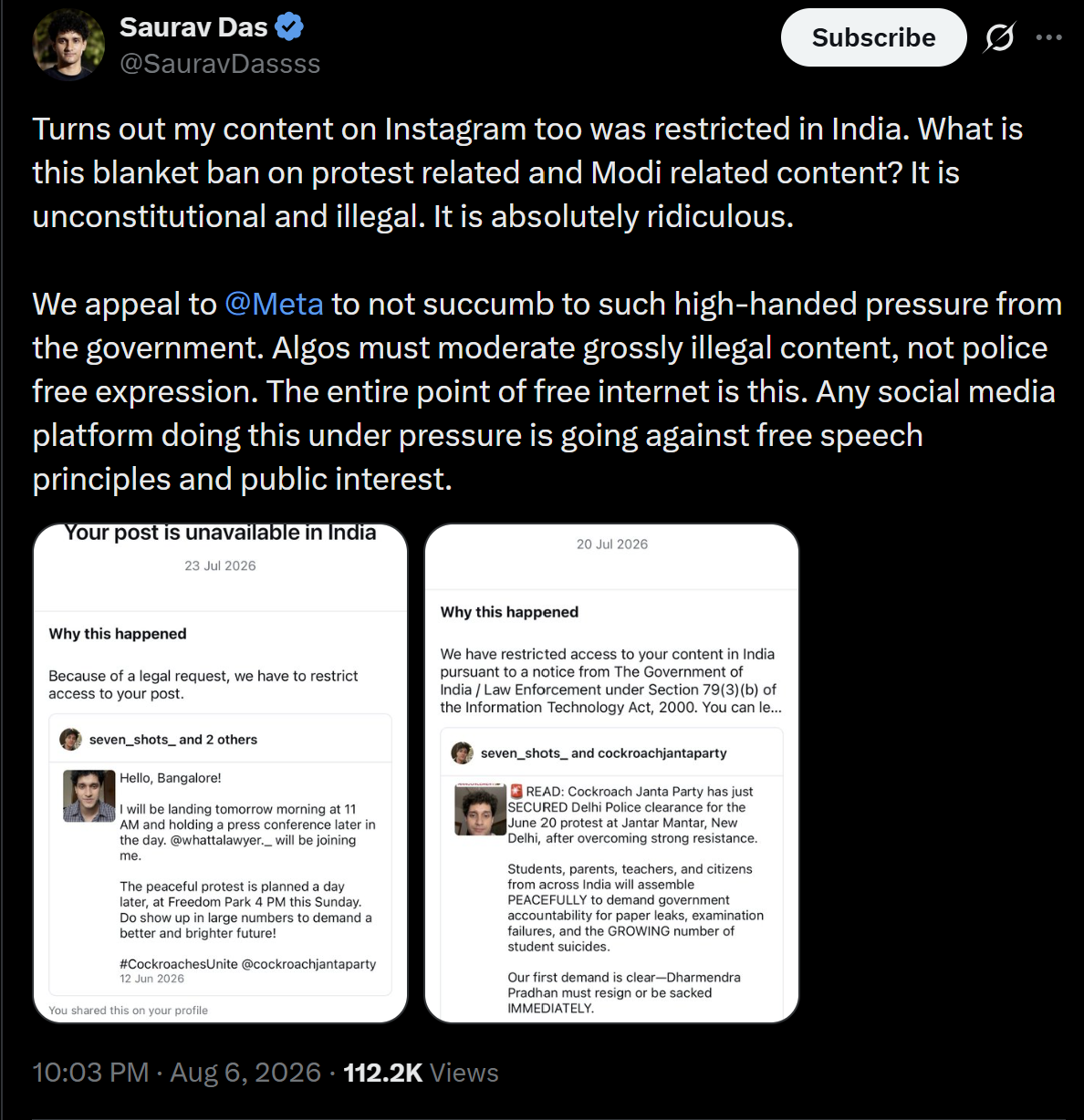
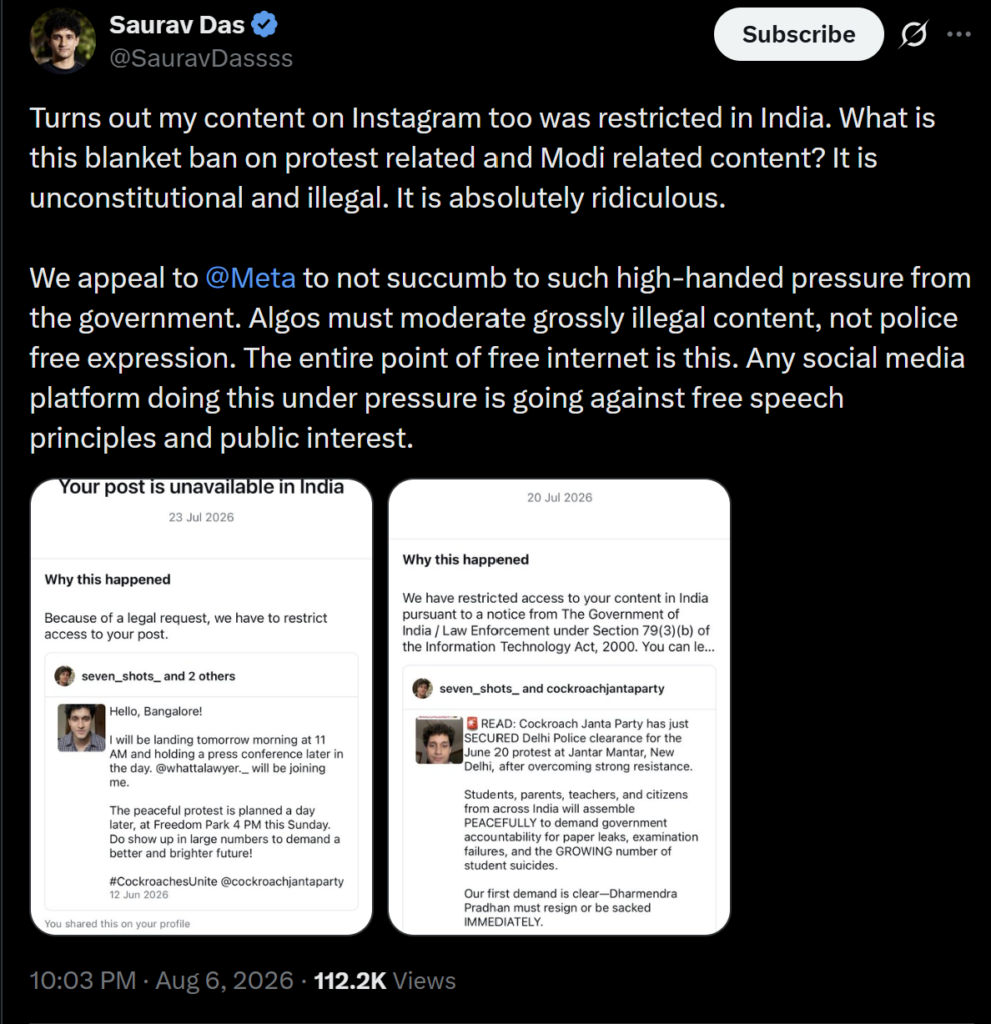
CJP’s Das shared on action taken by Meta following a request from the government.
“Turns out my content on Instagram too was restricted in India. What is this blanket ban on protest related and Modi related content? It is unconstitutional and illegal. It is absolutely ridiculous.
We appeal to @Meta to not succumb to such high-handed pressure from the government. Algos must moderate grossly illegal content, not police free expression. The entire point of free internet is this. Any social media platform doing this under pressure is going against free speech principles and public interest,” he said.
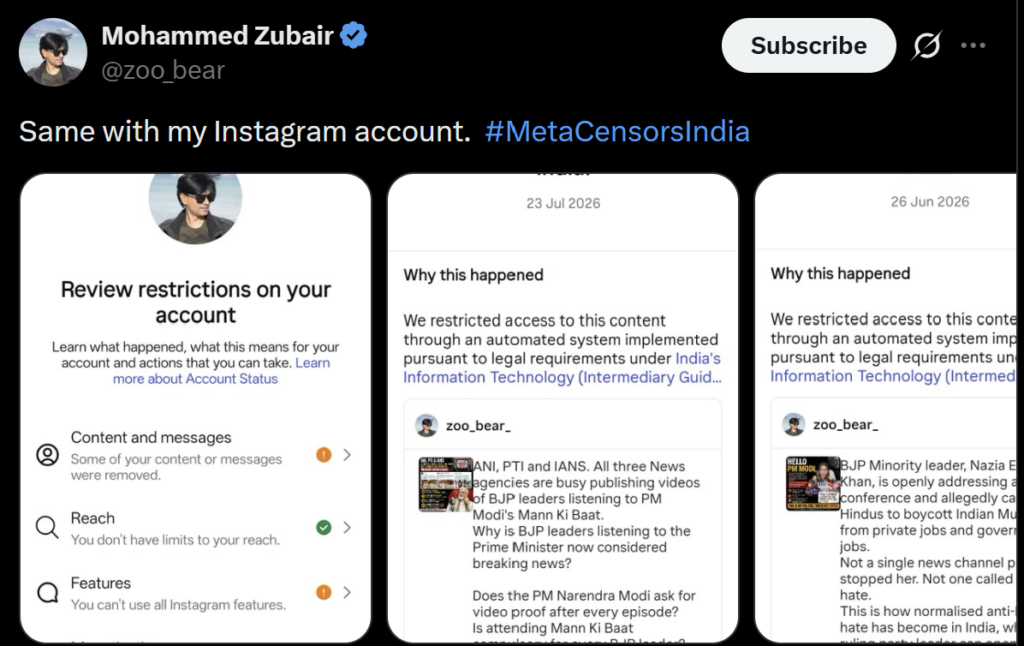
Zubair also shared a screenshot of the action on his account.
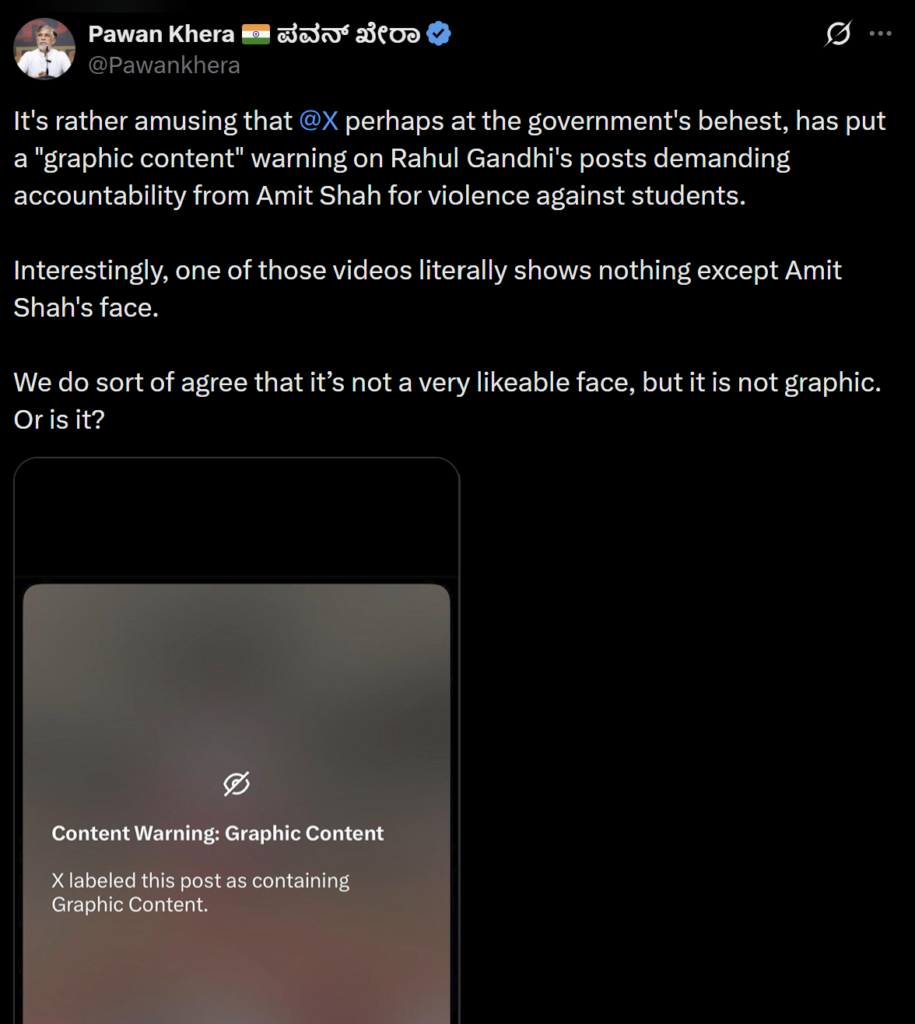
Congress Rajya Sabha MP and party spokesperson Pawan Khera shared a post from Gandhi’s social media post on which content warning has been displayed. The post carried photo of Home Minister Amit Shah with visual and music edits.
‘It’s rather amusing that @X perhaps at the government’s behest, has put a “graphic content” warning on Rahul Gandhi’s posts demanding accountability from Amit Shah for violence against students. Interestingly, one of those videos literally shows nothing except Amit Shah’s face,” Khera said
Digital rights body SFLC expressed concern on action taken by social media platforms on account of political leaders, activists, influencers and journalists.
SFLC said that @Meta restricted the Instagram accounts (“Platform”) of @AamAadmiParty (AAP), its national convener @ArvindKejriwal and Mohammed Zubair (@zoo_bear), co-founder of @AltNews.
It said that over the past week, along with these instances, http://SFLC.in has also recorded several instances of content takedowns faced by media organisations including @PeekTV_in, cartoonists such as @cartoonistrrs
and @cartoonistvish, and @SauravDassss – @Cockroachisback’s spokesperson.
SFLC said that according to the publicly available information, the affected posts were restricted pursuant to the “legal requests” received by the Platform.
“In many cases, users are provided little or no meaningful explanation about the legal or factual basis of the restriction or what steps they can take to challenge the decision. Such opaque moderation practices undermine users’ ability to understand how platform policies are enforced and make it difficult to distinguish between legitimate moderation and arbitrary or inconsistent decision-making. This is especially concerning where the affected content relates to political expression, criticism of public authorities, or peaceful protest, all of which occupy a central place in democratic discourse,” SLFC said.
It said that the Supreme Court of India upheld the constitutionality of Section 69A of the Information Technology Act, 2000 (“IT Act”), on the basis that the statutory framework required that blocking orders be reasoned, necessary, and proportionate, and that such reasons must be recorded in writing to enable judicial review.
“By contrast, in most of these cases, notices sent to social media intermediaries through the Sahyog Portal under Section 79(3)(b) of the IT Act and Rule 3(1)(d) of the IT Rules, 2021, leave users in the dark, with no recourse to meaningfully challenge takedowns and leave affected parties without legal redressal. The Sahyog Portal puts in place a parallel system to take down content online, without any of the safeguards present under Section 69A,” the rights body said.
SFLC said that it has consistently advocated against these practices.
“We are concerned that this takedown drive is contrary to the rule of law and to India’s constitutional commitment to freedom of speech under Article 19(1)(a) of the Constitution. While private platforms are not directly bound by the Constitution in the same manner as the State, their content moderation decisions increasingly influence the digital spaces in which democratic participation takes place,” SFLC said.
It said that any direction issued by public authorities requiring platforms to restrict lawful online speech must comply with constitutional safeguards and the legal procedures prescribed under Indian law.
“Informal or opaque restrictions on political speech or press freedom undermine public trust and democratic accountability,” SFLC said.
The rights body has demanded immediate disclosure of all takedown orders issued to platforms, including specific reasons and legal justifications, Strict adherence to the procedural safeguards laid out under Section 69A and the 2009 Blocking Rules, under the IT Act, which were upheld by the Supreme Court in Shreya Singhal v. Union of India.
SFLC has demanded that notices received by social media intermediaries be sent to every user affected to ensure transparency. and strengthening of independent oversight and appellate mechanisms to ensure that users can effectively challenge unlawful restrictions.
“Greater transparency from platforms regarding the number, nature, source, and outcome of governmental requests/orders for content removal and account restriction,” SFLC said.